TL; DR: Basic Requirements on Designing Water Park Lazy River:
| Key Metric | Commercial Standard (Global Compliance) |
| Target Water Depth | 0.9m to 1.0m (Maximum cap at 1.2m) |
| Minimum Channel Width | 3.0 meters (Recommended width; Allows passing clearance for dual rafts) |
| Global Turnover Rate | 1.5 to 2.0 hours (Strict MAHC compliance baseline) |
| Max Bather Capacity | 4.0 square meters of water surface area per person |
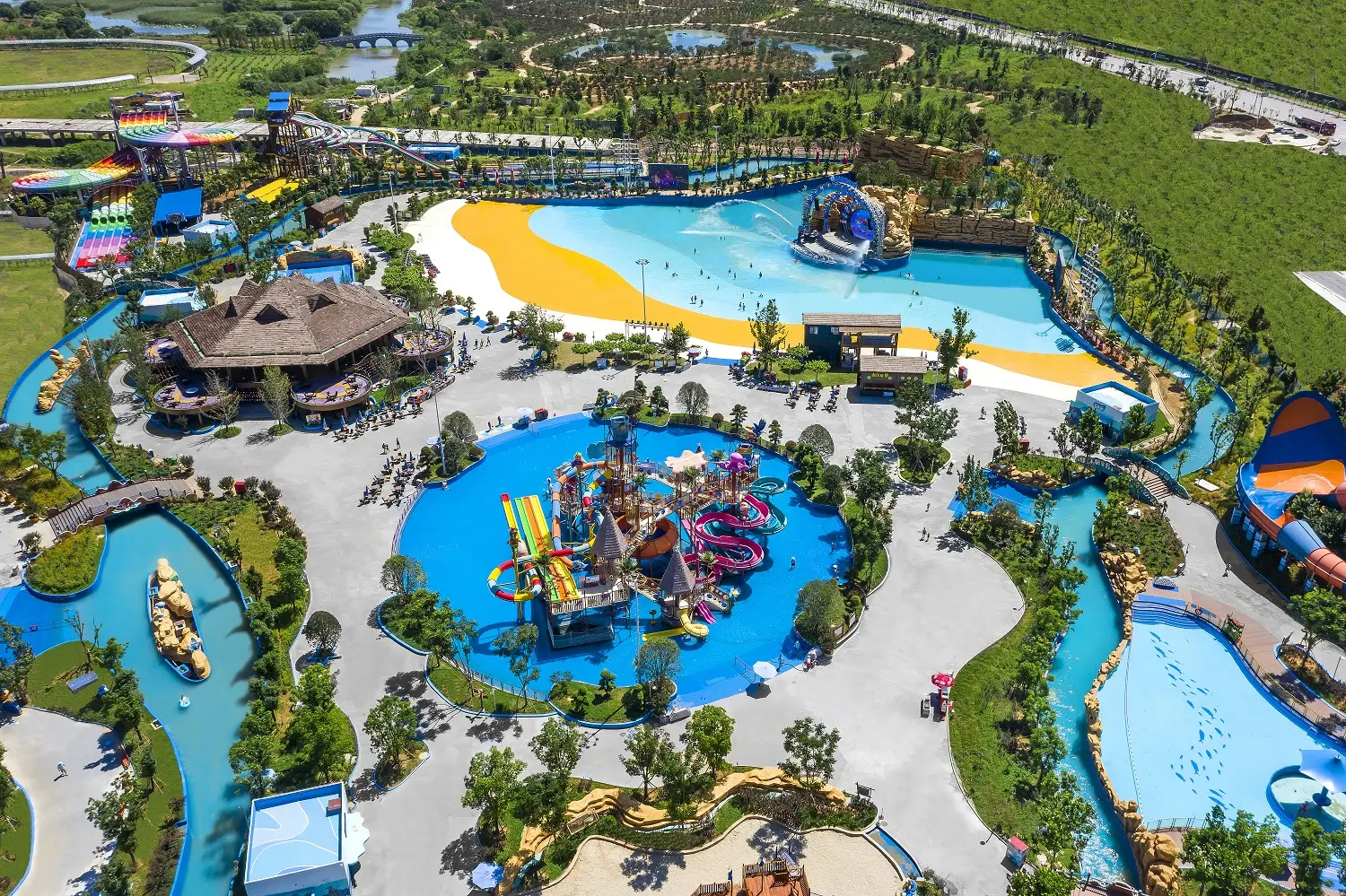
High-performance lazy river design requires balancing strict structural dimensions with aggressive hydraulic recirculation to guarantee safety and maximize guest throughput. Commercial developers must adhere to specific baseline metrics to satisfy international risk-mitigation codes.
This 2026 guide breaks down the essential engineering parameters, from calculating turnover rates to isolating splashdown zones.
What Are the Standard Dimensions for a Commercial Waterpark Lazy River Design?
A commercial waterpark lazy river requires a minimum channel width of 3.0 meters and a controlled operational water depth between 0.9 meters and 1.0 meters. These dimensions optimize guest velocity and prevent the severe operational liabilities triggered when water depth exceeds 1.2 meters.
Establishing a 3.0-meter channel width is the recommended enterprise baseline for a modern water park with lazy river. This span allows two multi-person tubes to pass side-by-side. Narrower channels immediately create stagnant bottlenecks when guests stall or stop drifting.
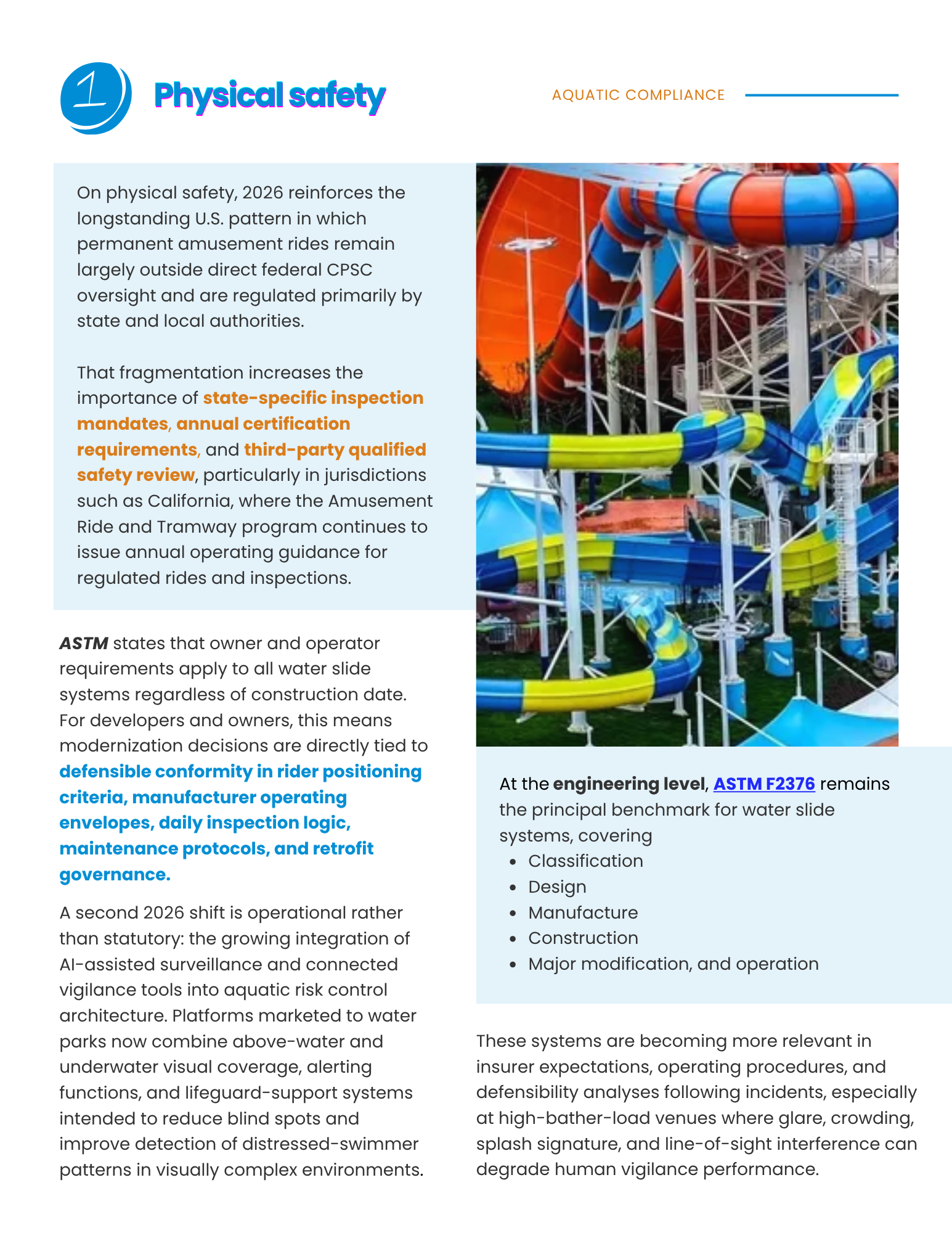
Deepening a river beyond 1.2 meters fundamentally changes its legal classification under ASTM F24 (Standard Practice for Amusement Rides and Devices) and MAHC (Model Aquatic Health Code) guidelines.
Exceeding this depth threshold increases insurance premiums and requires significantly higher lifeguard-to-guest ratios. Conversely, water shallower than 0.75 meters will cause rider tubes to scrape the concrete floor.
Well-calculated bather load ensures the filtration system can handle the biological demand of the guests, the calculation
- International capacity standards dictate 5 to 4.5 square meters of water surface per person.
- To find the maximum instantaneous capacity, utilize the standard calculation:
Total Surface Area / 4.0 = Maximum Instantaneous Capacity
How to Calculate the Volumetric Flow Rate for a Commercial Wave River?
Volumetric flow rate is calculated by multiplying the cross-sectional area of the channel by the target stream velocity. For a high-capacity wave river, this motive flow calculation must be paired with a strict 2-hour maximum filtration turnover limit to maintain chemical sanitation stability.
The core volumetric flow rate equation dictates how much water moves past a specific point per second. The explicit breakdown of this hydraulic physics formula is:
Q = A*v
- Q represents the volumetric flow rate
- A is the channel’s cross-sectional area (Width multiplied by Depth)
- v is the target stream velocity.
Standard drift rivers target 0.6 m/s to 0.9 m/s, while action rivers approach 2.0 m/s.
It is critical to differentiate between filtration flow and propulsion flow during the engineering phase. Propulsion flow is generated by in-channel motive pumps pushing water horizontally to create the current. Filtration flow uses completely separate external plant pumps to pull water through sanitation filters, replacing the entire volume every 1.5 to 2.0 hours.
High-volume motive pumps require extreme anti-entrapment protocols. Dalang enforces conservative safety metrics for all subterranean pump stations:
- Suction grid velocity is strictly capped at less than 0.2 m/s.
- Grates utilize dual, independent, unmovable structures with spacing under 8mm to prevent hair or finger entrapment.
What is the Estimated Engineering and Deployment Cost of a Lazy River Pool?
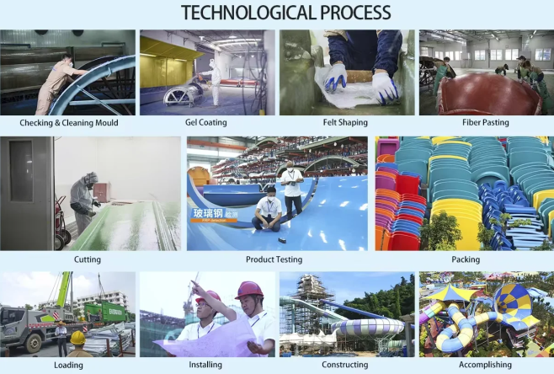
The capital expenditure cost of a lazy river pool at the commercial scale ranges from $1,500 to $3,500 per linear meter. This pricing is heavily dictated by soil conditions, the integration of advanced pneumatic wave generators, and the selected fiberglass molding processes.
Choosing the right structural material drastically impacts the long-term operational expenditure (OpEx) and maintenance schedule of the attraction.
| Material Attribute | L-RTM (Light Resin Transfer Molding) | Traditional Hand-Laid Fiberglass |
| Surface Finish | Double-sided smooth | Single-sided smooth (rough reverse side) |
| Friction Coefficient | Ultra-low (Reduces pump energy load) | Moderate to high resistance |
| Structural Lifespan | High structural density (20+ years) | Susceptible to delamination over time |
| Maintenance Cycle | Low localized gel-coat stress | High frequency of structural patching |
End-to-end turnkey engineering prevents cost overruns compared to fragmented third-party contracting. When civil foundations are poured without exact alignment to the fiberglass flume flanges, the resulting hydraulic misalignments cause expensive opening delays. Utilizing a single manufacturer for both civil planning and fiberglass fabrication minimizes the risk.
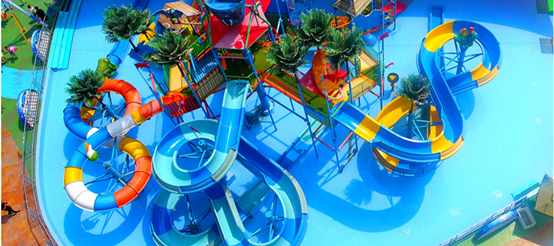
How to Design the Slide Entrances and Exits of Great Safety within a River Circuit?
Mind the absolute hydraulic isolation between high-speed water slide splashdown zones and the primary drifting current. These ingress and egress zones must utilize physical structural barriers and recessed staircases to prevent high-velocity collisions between decelerating riders and drifting guests.
Water slide runouts must never merge directly into a moving river current. Engineering protocols require a minimum 1.0-meter clearance zone and a structural concrete divider between the slide exit and the river path. This isolates the turbulent splashdown energy from the calm transit channel.
Access points demand a rigorous approach to architectural layout to ensure guest safety.
- All ladders and egress steps must be fully recessed into the concrete sidewalls; protruding steps violate international safety protocols.
- Propulsion discharge jets must be positioned a minimum of 0 meters away from any guest entry or exit staircases to avoid sudden current surges.
- Ground surfaces surrounding the entire perimeter must utilize non-slip textures with cross-grooved drainage pathways.
Volumetric Flow Rate & Turnover Calculator
Use the interactive application below to determine your required hydraulic performance metrics based on your planned river track dimensions and target regional compliance standards.
Water Park Turnover Calculator
Calculate pool volume, required flow rate (GPM), and turnover rate based on standard health code formulas.
1. Pool Volume (Gallons)
2. Turnover & Flow Rate Results
Frequently Asked Questions
What is the optimal water velocity for a commercial lazy river?
The standard motive velocity for a commercial lazy river ranges from 0.45 m/s to 0.9 m/s. Speeds approaching 1.3 m/s to 2.0 m/s transition the attraction into an “action” river, requiring specialized architectural engineering to prevent wave overspill on outer curves.
Discharging water from propulsion jets faster than 6.0 m/s creates localized turbulence that is dangerous to bathers.
How much does a commercial water park lazy river cost to build?
The capital expenditure for a commercial-scale lazy river typically ranges from $750,000 to over $2,000,000, averaging roughly $1,000 to $1,800 per square meter of water surface.
Total execution costs are primarily driven by the length of the circuit, geological site conditions, and the integration of high-horsepower axial motive pumps.
How do you calculate the maximum safe bather capacity?
While baseline commercial pool codes allow for 1.4 to 1.8 square meters per bather in shallow flat water, lazy rivers require additional spatial clearance for floating tubes.
The safest engineering standard allocates 3.5 to 4.0 square meters of water surface per rider. Enforcing a 4.0 sq.m density factor prevents tube clustering and ensures multi-person rafts do not jam during turns.
What is the difference between motive flow and filtration flow?
Motive flow is generated by high-volume, low-head pumps dedicated entirely to physically pushing the water horizontally to create the river’s current. Filtration flow is a completely separate hydraulic circuit that draws water through sanitation systems to meet health code turnover requirements.
Regardless of how fast the river flows, the filtration system must be sized to replace the entire volume of the river every 1.5 to 2.0 hours.
Executing High-Capacity Aquatic Infrastructure
Successful commercial river design requires viewing the attraction as a dynamic, high-capacity transit system rather than a static pool.
Dalang, a vertically integrated turnkey manufacturer, will have your back.
[Contact Dalang for All-Round Water Park Manufacturing Service]
Reference
- World Waterpark Association: CDC’s Model Aquatic Health Code (MAHC)
- Advancing Standards Transforming Markets: Committee F24 on Amusement Rides and Devices
- Pool Operation Management: Pool Capacity 101: What Every Operator Needs to Know for Peak Season
- Alberta Health Services: Information to Complete Anti-Entrapment Compliance Plan for Public Swimming Pools
- US Environmental Protection Agency: Field Operations Manual